
For any roofing project, repair, or inspection, knowing the roof terminology will help you communicate better with the roofing contractors. For the most part, roofing contractors will use specialized terminologies that may leave most homeowners baffled. Having basic knowledge of roof terminologies will aid in deciphering roofing estimates, pinpointing roofing problems, and being able to evaluate the roofing conditions of the home.
Being able to communicate effectively with the roofing professionals is key, and so for a roof replacement, maintenance, or any repair, knowing the terminologies is important. For this, we will look at all the important roof terminology.
Why Understanding Roof Terminology Matters
When the roof is built up, several components of the roof come together to help keep all the weather elements that harm the home, the moistures, and the home structures away. Contractors often use specific roofing structure terms when explaining the condition or design of a roof.
By understanding roof terminology, homeowners can:
- Comprehend inspection reports
- Identify and articulate concerns to contractors
- Detect roofing issues sooner
- Make decisions about repairs or replacements
- Understand the roof construction and the materials used
Knowing common roofing structure terms can also help homeowners avoid misunderstandings during roofing projects.
Basic Parts of a Roof Structure
When it comes to a roof system, learning advanced terms can wait, as it is essential to know the basic parts of a roof structure first. These parts provide the roof system with support and stability.
Important parts of a roof structure are the system’s major components. These are the rafters, the trusses, the decking, the underlayment, and the roofing. Together, they provide a system of protection for the house.
Some of the most common roofing structure terms include:
- Rafters: These are the slanted wooden beams that help support the roof’s deck.
- Trusses: These are structural frames that provide pre-engineered support for the roof.
- Roof decking: This is the first layer that the roof’s shingles or other materials are laid upon.
- Underlayment: This layer is installed as a protection layer between the roof decking and the roof’s topmost layer.
- Flashing: These are metal parts that help control the flow of water and prevent leaks around the joints of a roof.
These parts of a roof structure ensure durability, proper drainage, and structural strength.
Understanding Terminology Parts of a Roof
The terminology parts of a roof can be either visible or hidden, and they all have a functional role in the overall roof structure. The terminology for these parts is usually included in the roofing inspection and the estimate for repairs.
Some key terminology parts of a roof include:
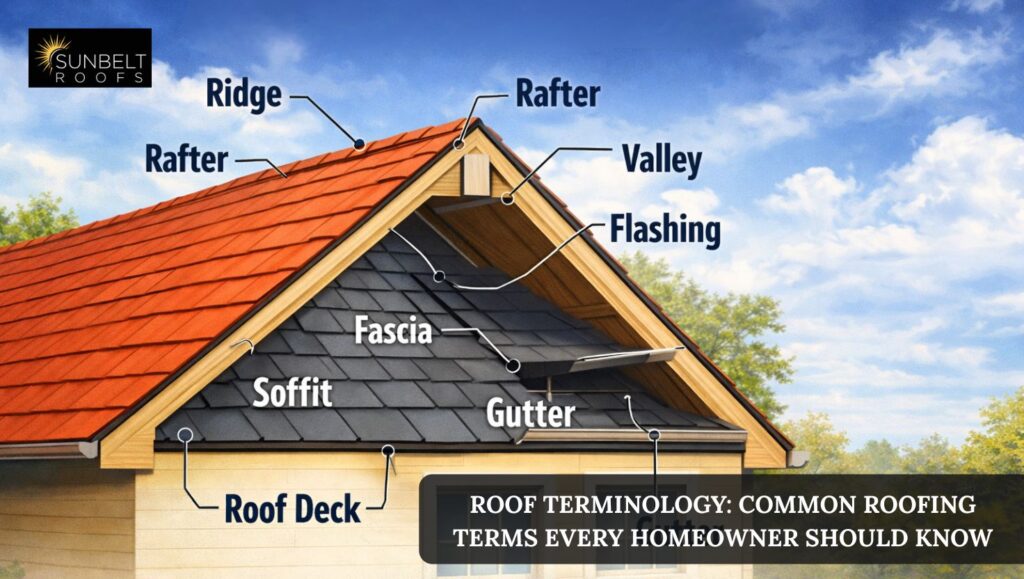
- Ridge – The point where two roof slopes meet at the top
- Valley – The point where two roof slopes meet to direct water
- Eaves – The eaves are the sections of the roof that hang over the walls
- Soffit – The underside of the roof overhang
- Fascia – The outer edge of the roof
When homeowners learn the terminology parts of a roof they become more familiar with the sections of their roof.
Learning Roof Terms with a Roof Terms Diagram
One of the best ways to learn the functions of a roof is to analyze a diagram of the parts of a roof. In a roof terms diagram, the different components of a roof are labeled, and the way the parts of the roof intersect is shown.
Diagrams usually mark structures like ridges, valleys, flashings, gutters, and roof decks. Such diagrams are helpful during a roofing inspection or when planning repairs.
A roof terms diagram gives homeowners the knowledge of how to speak to a contractor about the roof design.
Flat Roof Terminology Explained
Flat roofs are commonly used for commercial buildings and modern residential designs. Because their design is different from sloped roofs, they include unique flat roof terminology.
Some important flat roof terminology includes:
- Membrane roofing – Layers of roofing that are waterproof on flat roofs.
- Parapet wall – A wall that extends above the roof line.
- Roof drain – A drain that removes any standing water.
- Insulation layer – A layer that increases energy efficiency of a roof.
Understanding flat roof terminology is especially important for commercial property owners.
Unlike sloped roofs, flat roofs rely heavily on proper drainage and waterproofing systems.
Metal Roof Terminology for Modern Roofing Systems
Metal roofs are popular because of their unique and long-lasting qualities, their own terms, and their systems. However, they also come with their own set of metal roof terminology.
Common metal roof terminology includes:
- Standing seam panels – Vertical metal panels that are connected by raised seams.
- Metal flashing – A type of protective metal strip that stops water from leaking.
- Ridge caps – A type of protective cover that is put on roof ridges.
- Fasteners and clips – The accessories that hold metal panels in place.
Knowing metal roofing terminology is important for material and upgrade comparisons.
Homeowners should seek professional services like Metal Roofing Service if they want to have a metal roofing system.
When to Work with Professional Roofing Experts
Knowledge investing in roof terminology can make the most of learning the various systems in a roof; the ingenuity required to properly install these systems or make the necessary repairs, is still out of reach for everyone but the most experienced professionals.
Roofing professionals can inspect your roof, explain technical issues using simple roof terminology, and recommend the best solutions for your home.
Working with a Trusted roofing contractor in Louisiana and Mississippi ensures that roofing systems are installed correctly and meet safety standards.
Professional contractors also use detailed roof terminology during inspections, reports, and project planning.
Additional Roofing Knowledge Resources
Increasing knowledge of roofing systems and their components and structures is crucial for homeowners in order to understand various provisions and guides, such as Strong and Reliable Roofing Solutions.
The guides help with the various components of roofing materials, structural components, and the maintenance of roofing systems.
Understanding roofing concepts and roof terminology helps homeowners maintain their roofs and prevent long-term damage.
Conclusion
Every homeowner will benefit from knowing roof terminology. It is a great aid for understanding reports from inspectors, talking to your contractors, and knowing what to do for repairs and ongoing maintenance.
In addition, it greatly improves your ability to understand the parts of a roof structure as well as different types of roofs, including flat roof terminology and metal roof terminology.
Understanding the terminology parts of a roof gives homeowners the knowledge they need to take on a roofing project, and helps them protect the investment in their home in the long run.