

Commercial building owners who need a new flat roof or a full roof replacement often reach the same fork in the road. Two materials dominate the market, and the decision between them affects your building’s performance, energy bills, and maintenance budget for the next twenty years. Understanding EPDM roofing vs TPO is the first step toward a roof that actually holds up under Gulf Coast weather.
Both materials handle flat and low-slope roofs well, but they behave very differently once installed. Weather exposure, budget, building height, and even the direction your roof faces all play a role in which one performs better over time. Property managers juggling multiple buildings often default to whatever their last contractor used, which isn’t always the right fit for a new location. Anyone searching tpo vs epdm commercial roofing comparisons has probably already noticed most guides just repeat the same specs sheet. This one tries not to do that.
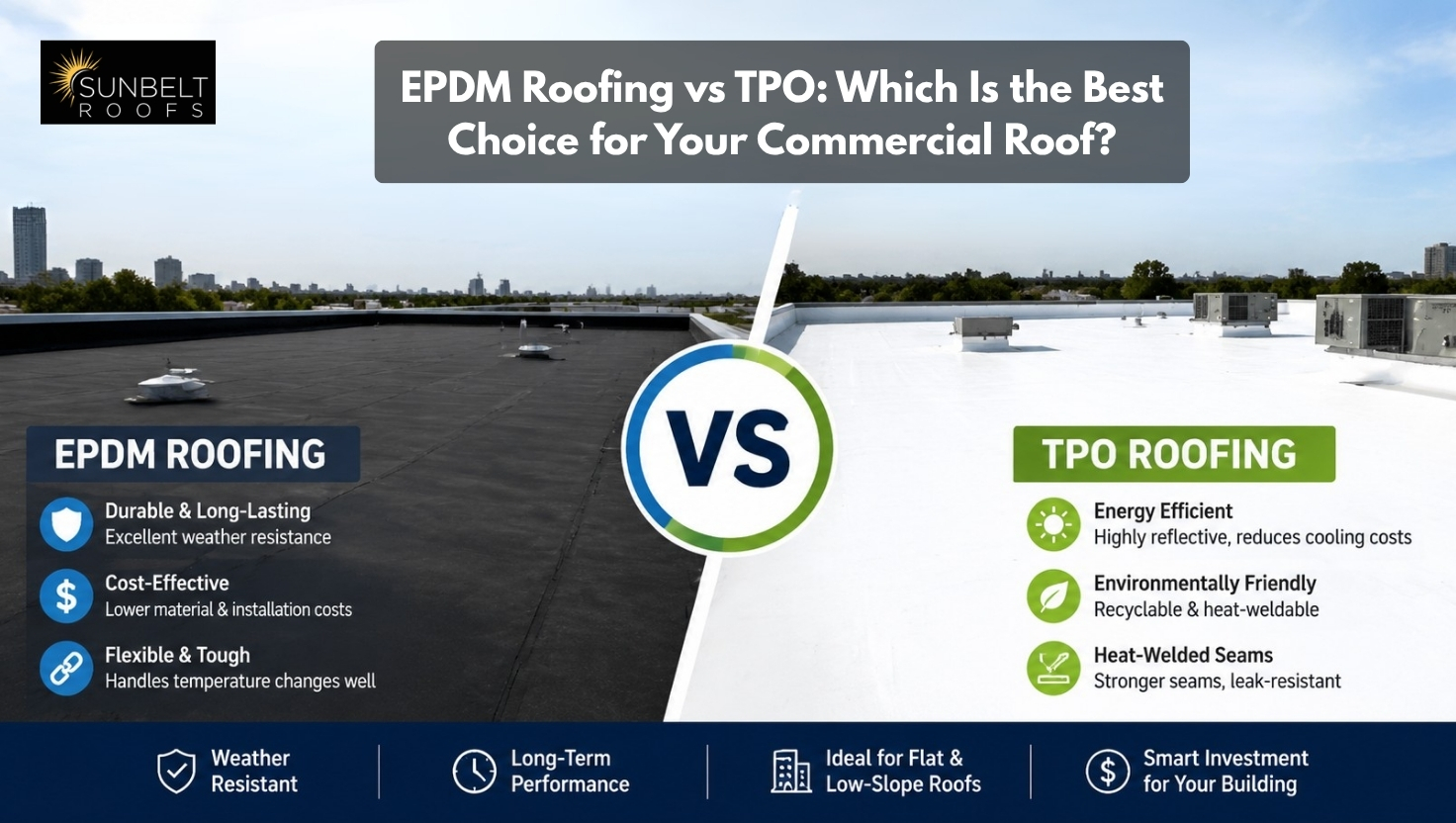
Quick answer: EPDM lasts longer and resists punctures better, while TPO reflects heat and welds into tighter seams. The right choice for EPDM roofing vs TPO depends on your climate, sun exposure, and how long you plan to own the building.
What this guide covers:
- What EPDM roofing is and how it holds up over time
- What TPO brings to a commercial roof and where it falls short
- A side-by-side comparison of EPDM roofing vs. TPO
- TPO roof cost and EPDM roof cost breakdowns
- Which flat roofing option fits your building and climate
- Common searches like tpo vs epdm commercial roofing and EPDM Roofing vs TPO, answered directly
Before choosing a membrane, it helps to see the full range of options available for commercial buildings. Sunbelt Roofs’ Fortified Roofing Services cover reinforced installation methods that extend the life of both EPDM and TPO systems, particularly in storm-prone regions along the Gulf Coast where wind uplift and driving rain test every seam.
What Is EPDM Roofing?
EPDM stands for ethylene propylene diene monomer, a synthetic rubber membrane that has been used on commercial flat roofs since the 1960s. It comes in large rolled sheets, usually black, and gets seamed together with adhesive or tape at the panel joints. Its rubber composition gives it a flexibility that few other membranes match, which helps it move with a building as temperatures shift through the day.
The biggest strength of EPDM is its track record. Roofs installed decades ago are still functioning, which gives building owners real confidence in long-term performance rather than a sales promise. It also resists cracking in cold climates and handles UV exposure reasonably well, though the black surface does absorb more heat than lighter alternatives during peak summer months. Maintenance is fairly straightforward too, since patching a small tear in rubber membrane rarely requires a full crew or specialized welding tools.
Key features of EPDM roofing:
- Rubber membrane with decades of proven field performance
- Excellent flexibility in temperature swings
- Strong puncture and impact resistance
- Available in ballasted, mechanically attached, or fully adhered systems
What Is TPO Roofing?
TPO (thermoplastic polyolefin) is a newer single-ply membrane that has been the fastest-growing selection in commercial roofing for the last decade. TPO sheets are heat welded at the seams, while EPDM is glued, creating a stronger, more watertight bond between panels. TPO roofing is usually white or light gray and reflects sunlight instead of absorbing it like a dark membrane does.
That reflective quality translates into lower cooling costs in hot climates, a benefit that many property owners along the Gulf Coast appreciate during long, humid summer months when air conditioning runs nonstop. Warehouses and retail centers with large flat footprints tend to see the biggest savings, since more reflective surface area translates directly into a cooler roof deck and less strain on rooftop HVAC units. For buildings that pair a flat roof section with a sloped section, Sunbelt’s Metal Roofing Services can complement a TPO installation on mixed-roof structures and give the whole building a consistent, coordinated finish.
Key features of TPO roofing:
- Heat-welded seams for tighter water resistance
- Reflective white or light gray surface
- Lighter weight than many alternative membranes
- Increasingly common on new commercial construction
EPDM Roofing vs TPO: Key Differences
When comparing EPDM roofing vs TPO side by side, the differences show up in seam strength, color, cost, and lifespan. Neither material is universally better; the right pick depends on your building’s sun exposure, budget, drainage design, and how long you plan to own the property before selling or renovating. Most tpo vs epdm debates really come down to two questions: how hot does the roof get in July, and how often does someone walk on it? A quick look at the specs side by side usually settles most of the back-and-forth.
Factor | EPDM | TPO |
Seam type | Glued or taped | Heat-welded |
Color | Black (light options limited) | White or light gray |
UV/heat reflectivity | Lower | Higher |
Typical lifespan | 20-25 years | 15-20 years |
Puncture resistance | Strong | Moderate |
Energy efficiency | Lower in hot climates | Higher in hot climates |
Best climate fit | Cold to moderate | Hot, sun-heavy regions |
The table makes one thing clear: EPDM tends to last longer and resists punctures better, while TPO wins on energy efficiency and seam integrity. For a Gulf Coast building baking under summer sun for months at a time, that reflectivity can matter as much as raw lifespan numbers on a spec sheet. Neither advantage cancels the other out entirely, so the decision really comes down to which trade-off costs you less over the years you own the building.
5 factors that should guide your decision:
- Local climate and average summer temperatures
- Roof slope, drainage design, and ponding water risk
- Budget for both installation and long-term upkeep
- Building type, such as warehouse, retail, or office space
- How long you plan to hold and operate the property
TPO Roof Cost Breakdown
TPO roof cost typically runs a bit lower than EPDM per square foot for material alone, though labor and specialized welding equipment can narrow that gap quickly. Most commercial TPO installations land in a mid-range price bracket depending on membrane thickness, insulation choice, and the condition of the existing roof deck underneath. This is usually where a tpo roofing vs epdm comparison gets real for building owners, since the number on the quote matters more than any spec sheet.
Quick answer: Pricing for a TPO system depends mainly on membrane thickness, roof size, and whether the old roof needs tear-off first. Larger commercial roofs often see a lower per-square-foot rate simply because of installation efficiency.
Thickness matters more than people expect, since thinner membranes save money upfront but wear faster under foot traffic, hail, and rooftop equipment. If you want a clearer sense of how long a properly installed system should last before replacement becomes necessary, our breakdown on how long does tpo roof last covers the variables that actually move the needle.
EPDM Roof Cost Breakdown
EPDM roof cost sits close to TPO on the low end but can climb higher for fully adhered systems compared to mechanically attached ones. Ballasted EPDM roofs, which use stone or pavers to hold the membrane down instead of adhesives, often cost less to install but add structural weight the building needs to support. Run the numbers on both before you settle on a tpo roofing vs epdm decision purely on sticker price.
Long-term maintenance costs tend to favor EPDM slightly, since the material resists punctures from debris and foot traffic better than TPO over a comparable stretch of years. Over a twenty-year window, the total cost of ownership can look surprisingly similar between the two systems, even when the upfront price tags differ.
Maintenance tips that extend either system’s lifespan:
- Schedule a roof inspection twice a year, ideally in spring and fall
- Clear drains and scuppers before hurricane season arrives
- Repair small punctures or seam separations as soon as they’re found.
- Keep foot traffic to designated walkway pads whenever possible.
Flat Roof Materials: Which Fits Commercial Buildings Best
Beyond EPDM and TPO, commercial buildings sometimes consider modified bitumen or PVC as alternative flat roof materials, though these show up less often on Gulf Coast projects. Most Louisiana and Mississippi properties still land on EPDM or TPO because of proven performance in humid, storm-exposed conditions and easier access to experienced local contractors. Availability matters more than people realize, since a rare material with no local installers can turn a simple repair into a weeks-long wait.
Coastal humidity and intense UV exposure put real stress on any flat roof membrane, and improper installation shows up fast in the form of seam failures and ponding water. Buildings in New Orleans in particular have reported specific failure patterns worth knowing about before you commit to a system, since local climate quirks don’t always show up in a manufacturer’s general warranty documentation; see our piece on TPO Roof Problems in New Orleans for real examples from local roofs.
Which One Should You Choose for Your Commercial Roof?
If your building sits under heavy sun exposure and you want lower cooling bills, TPO usually makes more sense for the budget and the tenants inside. If you’re prioritizing membrane longevity and puncture resistance over reflectivity, EPDM remains a dependable, proven option with a longer track record on flat roofs. Buildings with rooftop mechanical equipment or frequent maintenance foot traffic often lean toward EPDM for that added durability.
5 signs TPO might be the better fit:
- Your building has large expanses of flat roof under direct sun
- Energy bills from HVAC cooling are a major cost concern.
- You want heat-welded seams for tighter water resistance.
- Local code or your insurer prefers reflective roofing surfaces
- You’re planning a shorter ownership horizon of 15 to 20 years.
There’s no universal winner between these two systems, and any contractor who claims otherwise is oversimplifying the decision. Most epdm vs tpo roofing questions we get on-site come down to the same handful of concerns: heat, foot traffic, and how long the owner plans to stay put. The better question is which trade-offs fit your building, your budget, and how long you intend to hold onto the property before your next major capital project. Getting a second opinion on the roof deck’s current condition before signing anything is rarely a wasted step.
A roofing contractor who has installed both materials across your specific climate zone can walk the roof and give a straight answer instead of a sales pitch built around whatever membrane they have in stock. For hands-on guidance from a licensed team, Sunbelt Roofs’ Expert Roofing Solutions article covers what to expect from a full roof assessment before you sign a contract.
Conclusion
Choosing between EPDM roofing vs TPO comes down to climate, budget, and how long you plan to own the building. Both are proven flat roof materials capable of decades of service when installed correctly by an experienced contractor who understands Gulf Coast conditions. Whether you frame it as tpo vs epdm or flip the order, the underlying tradeoffs stay the same. Get a professional roof assessment before deciding, since existing deck condition and building specifics often matter more than the membrane brand alone.
Frequently Asked Questions
Q1: Is EPDM or TPO better for hot climates?
TPO generally performs better in hot, sun-heavy regions because its reflective surface reduces heat absorption and lowers cooling costs over a typical summer, especially on large warehouse roofs.
Q2: How long does a TPO roof typically last?
A properly installed TPO roof usually lasts 15 to 20 years, depending on membrane thickness, welding quality, and how consistently it’s inspected and maintained.
Q3: Does EPDM cost more than TPO?
Pricing is close between the two, though EPDM’s fully adhered systems can run slightly higher than a standard TPO install of the same size and roof condition.